Generating Form: A Three-Part Generative Workshop Series
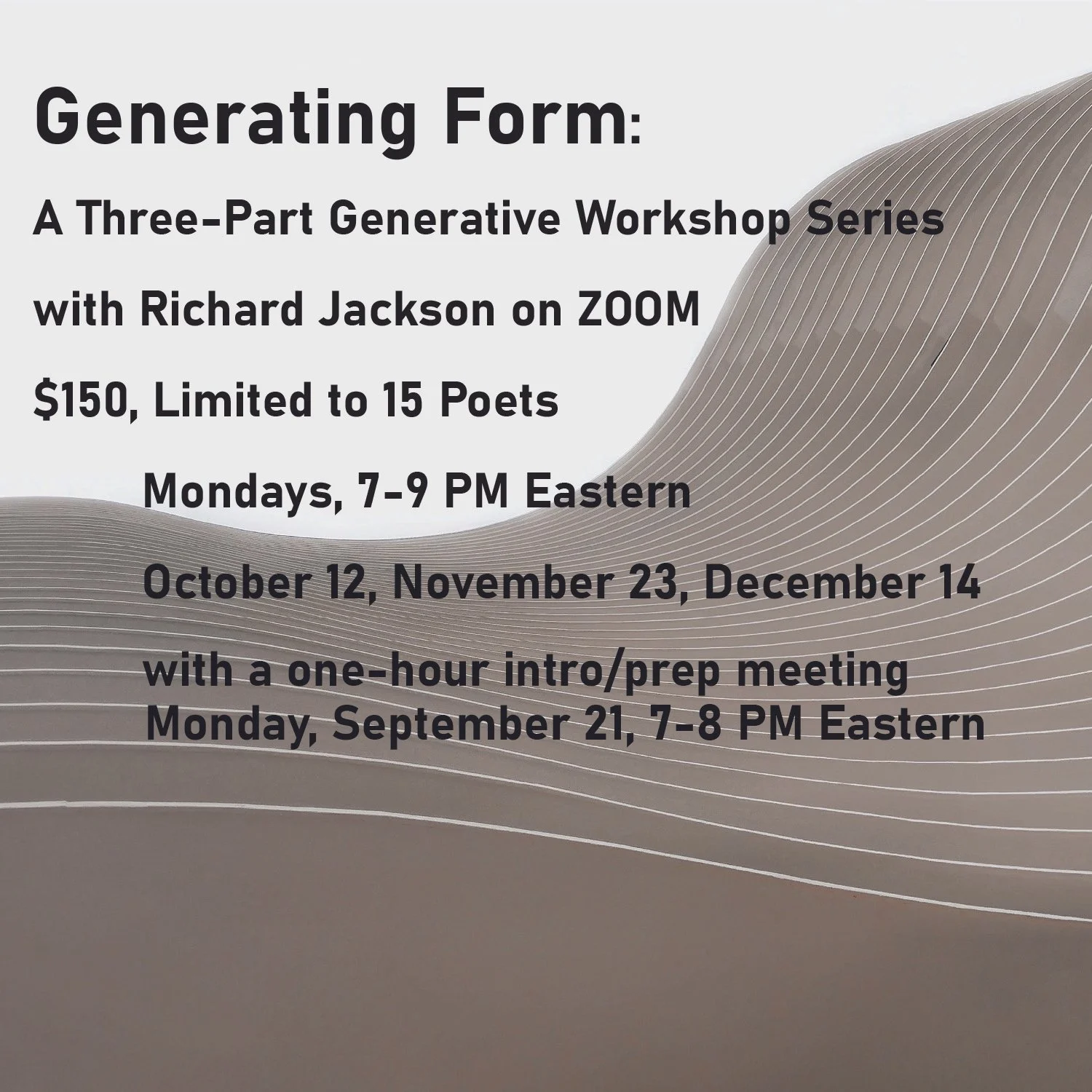

Generating Form: A Three-Part Generative Workshop Series
(Plus a one-hour introduction/preparation meeting on Sept 21, 7-8 PM Eastern)
with Richard Jackson (Limited to 15 Poets)
Mondays, 7-9 PM Eastern on Zoom
Session 1: The Sonnet, Oct 12 (7-9 PM)
Session 2: Villanelle, Sestina, Pantoum, Nov 23 (7-9 PM)
Session 3: Elegy and Ode, Dec 14 (7-9 PM)
In this generative workshop we will not only practice some traditional forms but also examine how our understanding of them can inform our own free verse poems. “Form is an extension of content,” as one saying goes, and “content is an extension of form,” goes another. Included in the workshop series is a free online booklet of examples and related essays. Cost: $150. Limited to 15 poets. Note: These sessions will be recorded for those who register and cannot attend.
Mark Strand and Eavan Boland write in The Making of a Poem: A Norton Anthology of Poetic Form, “poetic form, when it comes from deep feeling… is also deeply human…..The real story here is the inward grace.” They go on to make a distinction between the surface patterns and that “inward grace” or “deep feeling,” what Denise Levertov calls “organic form.” In other words, as Robert Hayden once described it: “Art is not escape, but a way of finding order in chaos, a way of confronting life.” Traditional forms, in other words, are not simply artificial constructs but specific ways of ordering our emotions and thoughts, and these patterns can be applied to out free verse. As Yusef Komunyaaka says in an interview: “I feel the poem. And these moments, these fragments, when I actually sit down, those pieces converge and flow together to make or create a more complete, whole reality. So it’s not like painting with numbers or anything like that, you know.” Whenever we put words together we follow some sort of order, some form, and often behind what we think is a free verse form lies the ghost of a more traditional form. Understanding form is essential to any art: for example, poems in English owe much to Old and Middle English metrical and stanza patterns that often are sort of ghosted beneath conventional metrical patterns forms and even beneath what we think of as free verse patterns. Even John Keats in 1819 used a sonnet to call for more freedom in the treatment of the sonnet form. In “On the Sonnet” he urged poets to loosen up the sonnet from traditional rigidity to allow it to find its own organic form. One has only to think of the variations of the sonnet form by Wanda Coleman and Terrance Hayes, for example, to see how we might use and extend various traditional forms.