WRITING POETRY IN DIFFICULT TIMES (Feb 17-Mar 31)
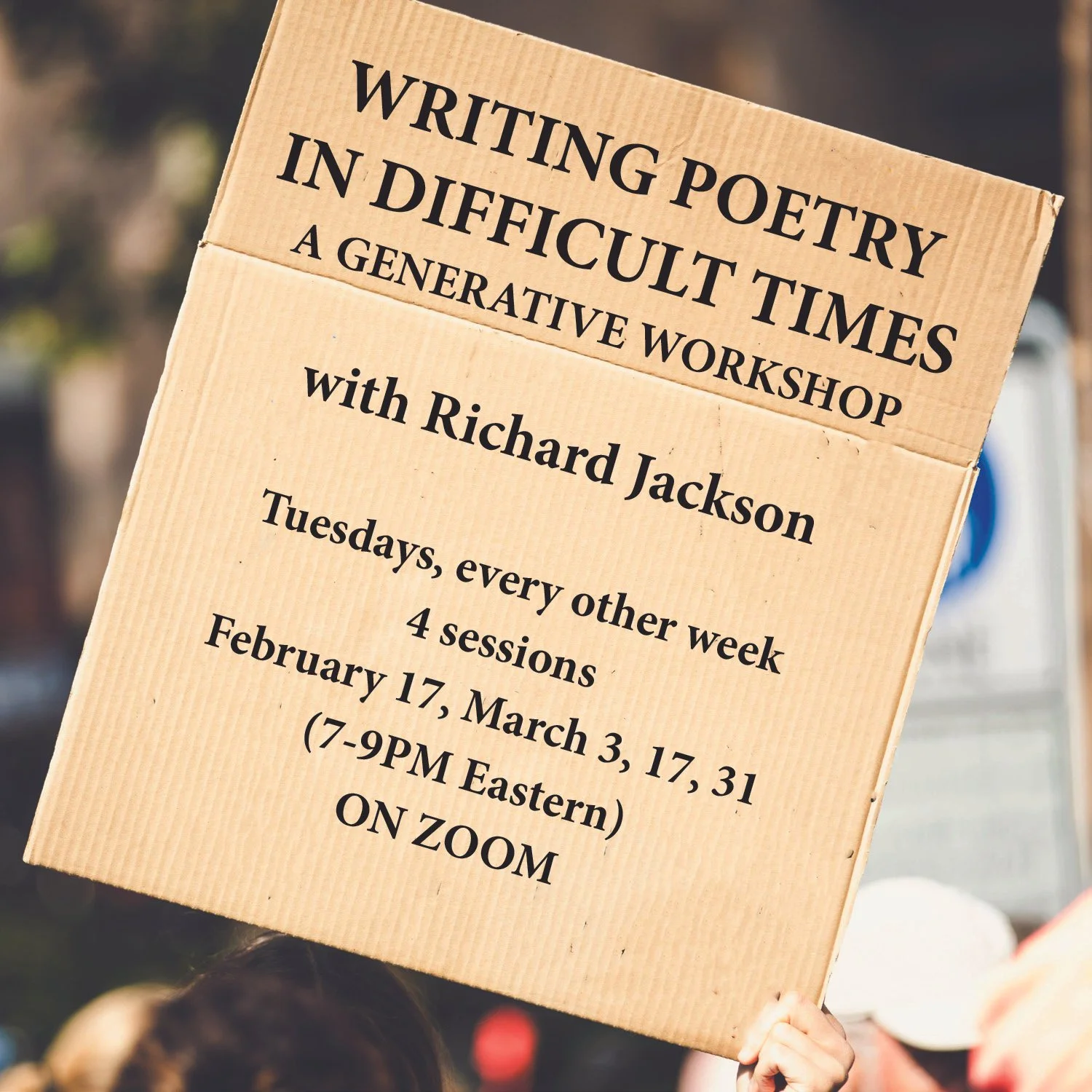

WRITING POETRY IN DIFFICULT TIMES (Feb 17-Mar 31)
A GENERATIVE WORKSHOP SERIES
with RICHARD JACKSON
Tuesdays, every other week, 4 sessions
Feb 17, March 3, 17, 31 (7-9PM Eastern)
In this workshop series we will be writing not about ourselves but our experiences of the world around us. Yes, we may refer to some tragedy or misjustice, though we should focus on the experience, especially of individuals; but we may also describe a sunset, the movement of tides, something that reflects the beauty and order of the world against a depressing world history. (This workshop series will be recorded for those who register and for those who register and cannot attend.)
“What are poets for in difficult times?” wrote the German Romantic poet, Friedrich Holderlin. To which the philosopher-theologian, Walter Bruggemann, wrote in The Prophetic Imagination “every totalitarian regime is frightened of the artist…the practice of imagination is subversive.” And recently novelist Connie May Fowler shared what she sent to her workshop reminding us that we are, as writers, “Civilization Keeper[s]: “During rising tides of fascism, every word we write is an act of resistance.”
But this does not mean we should turn from the art, structure and form of poetry to mere propaganda, for as Polish Nobel laureate poet Czesław Miłosz, who lived under Stalinist and Nazi occupation, once told me during the Yugoslav wars, it is not necessary to write something directly political; one can resist by writing something well-crafted as opposed to the chaos of dictatorships, something that reaches beyond the self and into the beauty of the world around us as opposed to the ugliness of hate that infects so much of society.
So in this workshop series we will be writing not about ourselves but our experiences of the world around us. Yes, we may refer to some tragedy or misjustice, though we should focus on the experience, especially of individuals; but we may also describe a sunset, the movement of tides, something that reflects the beauty and order of the world against a depressing world history.
Let’s keep in mind Stanisław Barańczak, another Polish poet, who writes, “regardless of theme and specific address, poetry is always some kind of protest.... That's why all the metaphors and rhythms―it's just a way of putting the world's chaotic gibberish in some meaningful order and restoring the original weight to abused words. That's why all the concreteness and conciseness―to resist the engulfing power of the world's empty abstractions and statistical generalities. That's why all the speaking in first person singular and seeing things from a strictly individual perspective―it's poetry's way of standing up to the world whenever it tries to elbow the individual aside and of the stage.”