Editor Selections for Issue 281
Poetry & Short Fiction


Short Fiction
Selected by guest short fiction editor Gerry Wilson
“Arletta (and the Fetus in Fetu)” by Laura Freudig
Poetry
David M. Alper
“Manual for Resurrection”
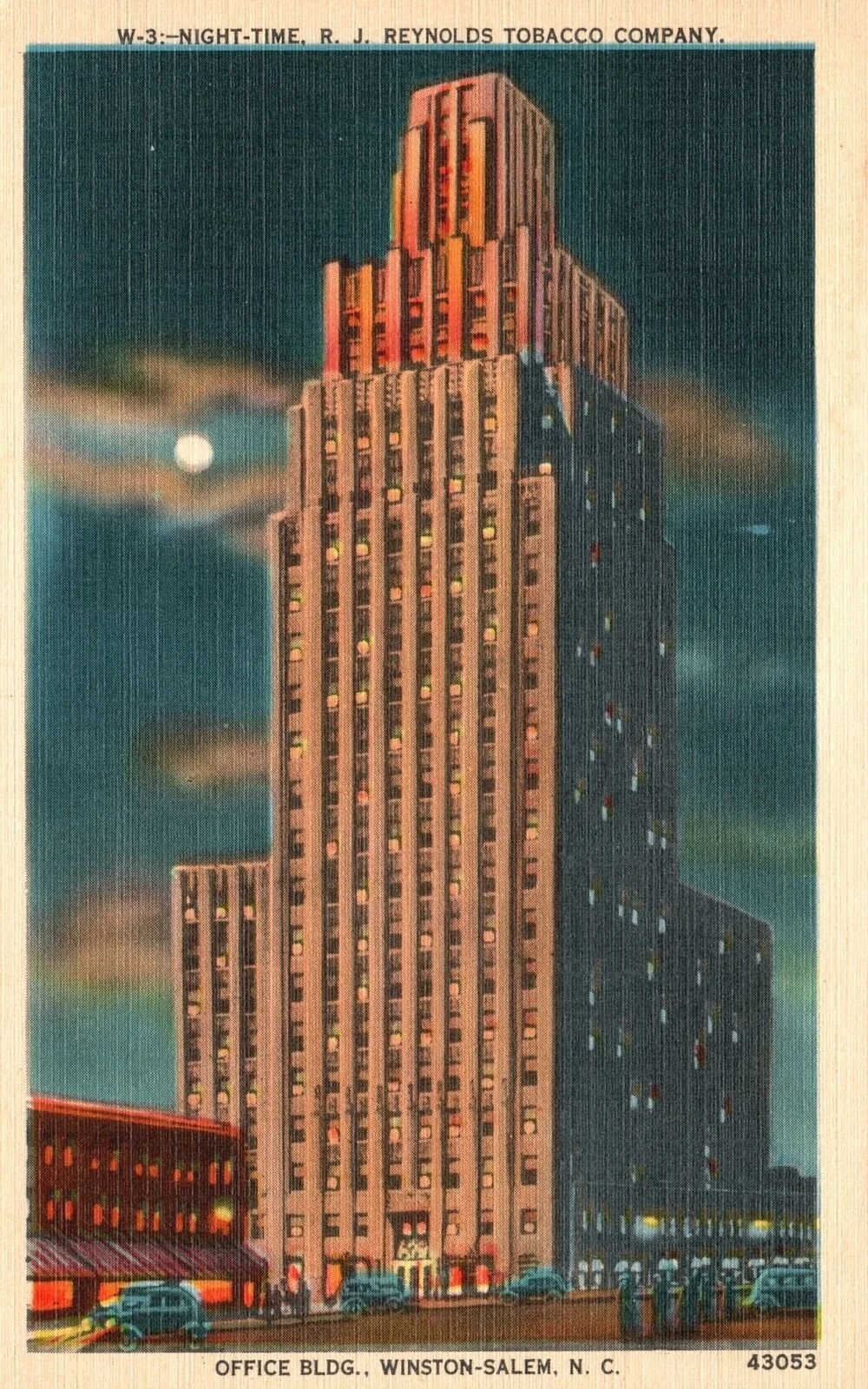
Note: David asked that we use a photo of downtown Winston-Salem, home of Press 53 and Prime Number Magazine. We opted for an old postcard image of the Reynolds Building, former headquarters for R. J. Reynolds Tobacco Company, built in 1929 and designed by the architectural firm that would later design the Empire State Building in New York City, built in 1931. Rumor has it that every year the Reynolds Building receives a Father’s Day card from the Empire State Building.
Manual for Resurrection
1. Begin with the lungs. Open them like letters never mailed.
Allow breath to come back as betrayal—cold, like a lover
who left and is thinking of knocking again. Breathe in until
your ribs remember they are not cells, but wings.
2. Purify the heart. With salt. With psalms. With the
names of the dead spelled backwards in candlelight.
If it still refuses to beat, sing to it. Sing with your
mouth a wound and the song the only thing that is not
bleeding.
3. Rejoin the hands. They will have to reach out to ghosts.
Let them. Then teach them how to cradle fruit again.
Teach them to sign your name without shaking.
4. The backbone is a prayer. Torch it. Break it if you
must. But reconstruct it with gold as the Japanese do
with bowls. Let your scars be the reason you're worth
keeping.
5. Don't trust mirrors. They are liars. They reflect the
body before the tempest, not the one that survived it.
6. When the night arrives— and the night will arrive—
cover yourself with the shadows.
Like a second skin.
Name it armor.
Name it mother.
Name it something that cannot be broken.
~ ~ ~
David M. Alper's poetry appears in The McNeese Review, South Florida Poetry Journal, The Bookends Review, and elsewhere. He is an educator in New York City.

Dustin P. Brown
“The Face Cast”
The Face Cast
I stepped on a ladder
and broke the first rung,
fell forward through it
and smashed my face
into driveway pavement.
The doctors marveled
at just how pulverized
everything in my head was.
They’d never seen breaks
so jagged, like the fjords
they’d photographed
during their last vacations.
They did the same with my
x-rays, took selfies beside
their idiosyncratic indentations
and had me autograph them.
Basically, my jawbone: cracked;
my forehead: smacked; my
nose: jacked; and my skull:
packed and wracked with hairline
fractures, tiny curves that
blossomed into intricate mandalas
so beautiful, I would have cried
had my eye sockets not lacked
supportive structures.
I spent five months in a full
head cast, just two nose holes
to breathe from and a mouth hole
to eat from. They gave me a seeing
eye dog for recovery, and we
bonded. When I finally got the cast off,
he left me. The doctors no longer cared
about me, and the ladder was still broken,
the leaky gutter I’d meant to fix still leaked.
Even my face ached for years after.
~ ~ ~
Michigan-native author Dustin P. Brown received his BA in Creative Writing from Western Michigan University. He’s worked as an editor with New Issues Poetry and Prose, Vaccei Editing, and Phylum Press. These days, he lives between his hometown in Michigan and his chosen city in Spain with his fiancé and two cats. He’s published poetry and flash in dozens of journals, most recently at ANTAE: Journal of Creative Writing, NonBinary Review, and Borderless Journal.

Maureen Martinez
“How to Start an Eating Disorder”
How to Start an Eating Disorder
Would you LOOK at the ASS on that one?
―Nanny on any beach in the 70s & 80s
Goldilocks-selecting
tangerine seashells with
just-so pearlescent sheen
Cool stone steps beneath the backs of young legs.
Glass ashtray makes a sexy sound as she puts
it down to take a long drag from her Marlboro
red, placing it next to her curvaceous bottle of Coke
on the open front porch, playing the leading role
for perceived neighbors behind lacey white curtains.
Lean legs crossed twice, once at the thighs and
again at the ankles to maximize their length,
leaning to the right. Knees stacked on top of one
another. Willow arms poised in checked gingham
tank. Manicured nails painted ballerina pink.
I knew as a girl I would become a smoker.
Knew my ass and nails would be perfection.
Knew I’d exchange starvation for adoration.
Knew I’d give to the point of near-extinction,
and they would love me for it.
pageant waving
to the bobbing blue
hydrangea
~ ~ ~
Maureen Martinez (she/her) is a late-blooming, emerging writer and irreverent woman of faith working at an all-boys Catholic high school in New York City for over twenty years. Her work has been published or is forthcoming in Gramercy Review, Folly Journal, Boudin, Prime Number Magazine, Washington Square Review, Artemis, Broadkill Review, Bar Bar, The Listening Eye and others. She comes from a long line of woodland ramblers, blood moon dancers, and raucous storytellers, which explains a lot.

Sarah Sorensen
“Wild Life Is the Red Edge on a Cool Leaf, Brittle with Want”
Wild Life Is the Red Edge on a Cool Leaf,
Brittle with Want
Black dog with polka dot haunches stretches up the tree, paws sleek. I love this day still swallowed in green, even as the edges betray me. I love. I love and love until it’s untenable. A dead brown leaf won’t tolerate holding. When’s the last second of air still pooled in sweat? Soon, it will collapse. The whole world around me, flayed to the bone. Hard. So hard the dirt won’t crack. But for a time, I have plunged my coyote’s tongue into the heart of the sweetest fruits. For a time, I have rolled on my back in the blades of soft summer grass. Look at the dog, stretched up the tree. Nothing but a pup on a lead. What does he know of the way love slips out the back door in the wet, white, dark? She held me soft, played over me like a summertime. Nothing but a pup on a lead.
~ ~ ~
Sarah Sorensen (she/her), MA, MLIS is a queer writer based in the Metro Detroit area. She has been published over eighty times in lit mags, but her most recent work can be found in Another Chicago Magazine and Garland. She's honored to be a Best Small Fictions 2025 and runner-up in the 2025 Rock Paper Poem Poetry Contest. Sarah is currently completing her first novel, despite an array of distractions from her fiery dog daughter and unstoppable cat son.
Short Fiction

Laura Freudig
“Arletta (and the Fetus in Fetu)”
Arletta (and the Fetus in Fetu)
The clinic’s website stated up front, “No guarantees of weight loss results.” Arletta printed out the information and went into the kitchen to start dinner. Her hips, shoulders, and upper arms pressed against the doorframes and walls in the hallway as she passed: she was encased in her own house like a caddis-fly larva or an animal whose tunnel was the same diameter as its body. Behind her, the pages glowed slightly in her mind, like the sun shining at the distant entrance to the burrow, beyond hummocks of earth and the waving ends of worms and roots.
Later that evening, when Ed was in the basement and Clary was at Dairy Queen with the basketball team, Arletta got the pages out again. This was further down the page, in a smaller font: “All surgical procedures carry inherent risks. Serious life-threatening complications may occur including, injury to tissues and organs, bleeding, infection and internal scarring that can cause long-lasting dysfunctional pain.” She tucked them in her pocket and went downstairs.
She put one hand on each railing, stepped with her left leg, then lowered the right leg down to the same step, adjusted her grip on the railing, and stepped down again. The stairs sagged beneath her; the basement smelled of wet cement and sawdust.
Ed was standing at his workbench but had turned to watch her descent, warily.
“I’ve got something I want to tell you.” She edged a cardboard box toward the pile of trash ready to go to the dump. “It’s a mess down here.”
Ed’s workbench was cluttered with half-empty boxes of nails, baby food jars of nails, tangles of cords snaking from chargers to outlets, and tin cans full of washers and wires and batteries. He would spend a cheerful fifteen minutes looking for a single screw. Behind the workbench, on the wall, hung the license plates of every car he’d owned since high school. He waited while she caught her breath.
“I want to go to Mexico to get my stomach stapled.”
He turned a drill bit over in his fingers. “You don’t need to.”
He’d said this so many times in the last twenty years and in so many different ways, that she knew she ought to believe him.
“This’ll be the last thing, I promise.” She hated saying that—admitting to the failure of two decades of herb pills, diet books, colonics, exercise videos, food fads and fetishes. She once pretended to eat nothing but grapefruit for three weeks.
Just then they heard the front door crash, Clary’s exasperated shout of Mom! and her feet stomping down the basement steps.
“Quick! I need twenty dollars!”
They just watched her for a second. It was their one weapon: the refusal to be drawn in.
Clary threw her hands down to her side and let out an exasperated breath that was almost a growl. “They’re leaving!”
Ed was rooting in his pocket, picking out receipts and paperclips and pencil nubs and lining them up on the workbench. He met Arletta’s eyes for a second and gave her the little squint which was code for a smile.
“What happened to your allowance?” Arletta asked.
“Come on! Please! I loaned it to Sam!” There was a slight pause before the boy’s name and a look that Arletta had never seen before—embarrassed, pleased, secretive, a dash of fury sprinkled on top like cayenne pepper.
Clary once brought crooked songbirds home in cupped hands, made beds for broken snakes, demanded Arletta fix the twitching, damp mice the cat dropped on the porch steps. Arletta remembered her tiny, grubby fingers with their difficult gifts; she wondered where Clary brought her pleas and sacrifices now.
By this time Ed had extracted a few bills from his pocket and was peering at them. He waved one of them at her, and she snatched it.
“Thank you! God!” She clattered up the stairs and out the front door. A minute later, they heard her come back in, then her bedroom door slammed and a distant bass thump, like a heartbeat, began.
“How long would you be gone?” he asked as he began to refill his pockets with all the things he had taken out.
“Two weeks.”
“Alright,” he said and turned back to his workbench. Arletta hauled herself upstairs where the bass heartbeat was louder. She felt trapped between industry and mayhem. She stood in her room, holding the papers, wishing that she could find the right words to tell Ed what it felt like to live in this skin, but it was impossible to squeeze what she felt into words that didn’t leave a crucial part miserably bunched up or unfairly exposed. She was too big and not enough, at the same time.
* * *
The next day she made the appointment and forked over five thousand dollars.
* * *
Arletta didn’t know what to expect in Mexico. If the clinic wasn’t quite as clean as the pictures in the brochure, and the nurses didn’t smile so continually, and the portico outside her room actually faced a highway, the pictures also didn’t capture the quality of light and the depth of the sky. She lay on a chaise lounge outside her room, breathing in dust and diesel, patting the bandages over her three laparoscopy incisions, and felt the sun touch her in ways nothing ever had before. She imagined her stomach, now the size and shape of a banana, in a svelte yellow sheath dress, reclining on her large intestine, one foot perched on her gallbladder. She drank a sip of strawberry daiquiri and felt full for the first time in her life. She had always been continually empty, like a sieve. In that sun, she felt like she was being refined, melted and reforged, and because she saw no one except the nurses (and there were no mirrors), she believed it until she got home.
Outside the Bangor airport, the car sank down and the suspension groveled as she wedged herself into the passenger side of their brown sedan. Ed reached over and clicked in her seatbelt, the way he always did.
“You want to stop at Dunkin’ Donuts?” he asked as he pulled away from the curb.
Her largest wound—the one that bisected her belly button—suddenly throbbed. She looked out the window at the ankle-deep slush on the side of the road. Maine was in the midst of a resurgence of winter, the sky and ground both the color of old birch trees. She said, “I’m on a liquid diet.”
“They sell liquids,” he said, glancing over his shoulder as they merged on to I-95.
“No, thanks,” she said. “Go ahead if you want.”
“No, I’m good. You’re the one who always wants to stop.” His voice had just a hint of accusation.
The yard, when they pulled in an hour later, was full of ruts from the plow truck and craters of mud and ice. Ed took her arm as they went up the walkway though he could no more have stopped her from falling than he could have stopped a runaway piano rolling down a set of stairs.
Winter retreated, and Arletta began to shrink. The tide of skin went down: every day a thin t-shirt of flesh dissolved. By the end of a week, she was thinner by a sweater; by the end of a month, a winter jacket. Two months later, it was as though she had taken off the costume she had worn her entire life. She hardly recognized her own body; nothing was where she remembered. It was unexplored territory: when was the last time she had seen the skin under her third chin, the interior of her own armpit? Her mouth yearned for the crunch, the wet sweetness, the salt tang of food, yet she was as full as if she had been gorging on the missing flesh.
* * *
When Dr. Araya called for a post-op checkup, she mentioned the hard mass at the top of each of her thighs.
He laughed. “It is your pelvis, I think. Say hello to your skeleton, Mrs. Jones.”
She couldn’t remember the feeling of bones under her skin. She had been a heavy child, growing up in Georgia with a mother who smothered every emotion with gravy and a grandmother who took pride in Arletta’s ability to clean a plate. She ate everything set before her—fried chicken and okra, salads of canned fruit suspended in Jello, biscuits three inches high, mashed potato, cornbread, glistening glasses of sweet tea with piles of sugar wafting at the bottom. Each mouthful was a statement about something: love, solidarity, authority, comfort, despair. She remembered scorching summers, shifting position with the deliberateness of continental drift, arms and legs and stomach sliding against each other on a cushion of sweat.
She went to college in Virginia, graduate school in Pennsylvania, got her first teaching job in New Jersey, and met Ed at an educational conference in New York. Shortly after they got married, he accepted a job in Maine. She had worked her way north without realizing it, finding safety in winter layers. She would never have to wear tank tops and shorts or expose her broad expanse of dimpled skin to the searing eye of day; she could burrow herself in sweaters and sack-like dresses. She had a PhD in Curriculum Development and sat behind a mahogany desk three times as wide as she was.
Dr. Araya had also said, “Vamonos, Mrs. Jones! You must walk.” But she did not. She looked out the window as the buds on the trees swelled and the branches filled with twittering and the flicker of dark wings. She stood by the door in her sock feet, then turned away.
The tide of flesh continued receding—thirty, fifty, seventy, one hundred pounds—and bones emerged like sunken atolls all over her body. Ed seemed unnerved by her new geography. His hands would wander across her chest, her flank, down the well-traveled highways of desire, and stall out after a few minutes, falter, and retreat. He would clear his throat, whisper what he always did—"Oh, so soft"—give her a pat, and roll away. At the dinner table, he would glance over at her and twitch, startled by something he wouldn’t name. He taught algebra, geometry, and statistics to pimply, unprepared eighteen-year-olds at the local community college; in his spare time he avoided anything requiring calculations. Arletta realized she had somehow become an unknown variable.
* * *
It was high summer when she first heard the murmuring coming from her side.
* * *
She lay in bed that night after Ed’s breathing slowed and roughened, and ran her hand across the spot. If this was a bone, it was closer to the surface than any of the others, a hard mound that fit her cupped hand. Her bones had been drenched, sunken, drowned in flesh. She closed her eyes and tried to imagine what was about to—after such a long submersion—break the surface and gets its first taste of air and sun.
“They are not brittle,” Dr. Araya assured her. “Your bones have been carrying around three hundred pounds for decades. Your bones, Mrs. Jones, are immensely strong.” So the noise she heard wasn’t the vague echo of metal fatigue, deformation, or structural failure. She wasn’t a ship about to break apart or a tower about to pancake into rubble. But the sound continued, a low whine that rose and fell like an old woman’s petulance heard through a wall.
“Do you hear that?” she asked Ed the next night.
“What?”
“I don’t know, like a humming sound?” She pointed to the spot.
He leaned over and listened. His eyes widened, narrowed; they seemed to recede into his skull, as though he were moving away from her. “You must be gassy.”
“That’s probably it,” she said, pulling away.
* * *
The mound under her skin became more distinct every day, and above it, Arletta’s skin thinned and peeled. In bed, she pulled up her nightgown and fingered it, picking off loose flakes like sunburn. One night, a small hole appeared, which she widened with a curious finger. There was something sharp inside. She remembered the sudden shock—sixteen years ago—of touching a tooth in Clary’s tiny warm mouth. Something like a dry tongue flicked against her finger, and she jerked her hand away. She got out of bed—Ed snorted and stirred but didn’t wake—and locked herself in the bathroom. She lifted her nightgown and tucked the hem under a breast, squinting in the sudden light.
It looked like a bruise, a dark shadow under her skin. A thin lip of pinkish flesh stretched around a hole the size of a pea. An entrance. Arletta felt a little spurt of excitement, like low tide was revealing the corner of a box long buried in mud. The humming was louder.
She sat down on the toilet and tried to get a closer look with Clary’s makeup mirror. It was hard to tell what was going on, and she was afraid to stick anything—her finger, a Q-tip, tweezers—inside. She felt like she’d cornered a small, fierce rodent with her bare hands.
Gingerly, she pinched a curl of skin at the opening, and the entire membrane began to peel off in a circular fashion, like the plastic ring on a sealed jug of milk. She kept pulling. The last bit tore away, and a drop of blood welled up. She blotted it with a square of toilet tissue, wincing slightly.
Arletta felt a puff of air against her thumb and heard a tiny hiss of breath. Sssssssssss, like a teapot about to boil.
In the mirror she saw a circular ring of tiny white teeth with a darker opening in the center. A throat.
She said, tentatively, “Hello?”
Her vision shrank to a pinhole, and she tilted sideways against the sink. A wave of nausea, thick and oily and clotted with seaweed, rolled over her. An ulcer, an infection, she thought. Maybe something they’d left inside her during the surgery had worked its way to the surface. Hadn’t she read something about scar tissue? This was just a complication, a side effect. What had made her say hello? She clapped gauze and tape over the opening and crawled back into bed, but not before noticing that the surface of the gauze sucked in and out—just slightly—out of rhythm with her pulse and her breath.
* * *
The next morning Arletta made an appointment with her primary care doctor, who was able to fit her in at eleven.
She sat unsteadily on the exam table, teetering between panic and a strange sort of excitement. The paper crinkled, warmed, and tore beneath her. The room had a hot, electric smell.
Her doctor came in, wearing a loose white coat and a long skirt, and sat on a stool with her knees apart, rubbing hand sanitizer between every finger.
“You’ve been hearing a humming sound?”
Arletta nodded. That was what she had told the medical assistant who weighed her and took her blood pressure.
“In which ear?” Dr. Price asked, then continued without waiting for an answer. “You’ve had a lot of changes lately. You’ve lost—what—" she consulted the computer on the counter next to her, “close to a hundred pounds. How are you feeling about that? Your family?”
She had a pleasant blank stare that Arletta thought was intended to invite confidences but was in itself a judgment. Arletta was familiar with people who asked for secrets without offering any in return, thinking obesity was a boil that needed to be lanced with confession—people who also thought they would never be fat, old, or impaired.
“Have you considered that the sound could be your body’s way of responding to negative voices, shutting them out?”
“Well,” Arletta said, “that’s something to think about.” She paused and tugged up the hem of her johnny. “Since I'm here, could you look at this?”
“Of course,” Doctor Price said, scooting her stool closer.
Dr. Price eased off the bandage then sat blinking for several seconds as if her eyes were trying to swallow something sharp. Arletta felt a certain satisfaction at her silence. She could also tell that Dr. Price heard the humming, too, by the way her head tilted, suddenly, as though someone had forcibly twisted it.
She pushed her stool back to the computer and began typing rapidly, nodding to herself.
“It’s called vestigial or parasitic twin syndrome,” she said, scrolling up and down on the computer screen. She sounded like she was talking to herself, and Arletta wondered if a response was required and what it should be. Interesting! You don’t say! As though Dr. Price’s research skills were the marvel, not Arletta herself.
Arletta had been delivered with upsetting medical new before: every weigh-in, every extra twenty pounds, the day a different doctor had told her she had a BMI of 67, would be unlikely to get pregnant again.
“You are part of a rare form of conjoined twins, consisting of—I’m reading here—an incomplete twin—the parasite—attached to the fully developed body of the co-twin or autosite. It’s also called fetus in fetu. Fetus in the fetus. Or perhaps the fruitful fetus.” Dr. Price turned away from the computer near the end of this monologue, and Arletta realized she was talking to the opening in her side.
“Why are you talking to it?” she said.
Dr. Price smiled at Arletta’s leg. “Actually, it’s a she. Vestigial twins are always one of a set of identical twins. So, she. Your sister, actually.”
Arletta had a return of the falling sensation from the night before and gripped the side of the exam table, her fingers crumpling the thin paper.
Dr. Price began typing into the computer again. “Did your mother know she was having twins?”
“What? No.” Arletta paused. “I have no idea.”
All her mother ever said—and she’d said this to anyone who would listen—was I was so huge I stopped traffic. Split me open stem to stern.
“I want it removed.”
Dr. Price clicked away on the computer, with more force than strictly necessary. “I realize she needs to sign the consent to treat form first.” Her voice flattened and faded, as though she were talking through a plexiglass partition. “We can come up with some alternative way of doing that if signing is unfeasible.”
Arletta slid off the exam table, taking a large portion of the paper cover with her. She pulled it out from between her buttocks and reached for the bandage which Dr. Price had placed next to the computer. She pressed it over the opening and grabbed at her clothes on the plastic chair next to the exam table. Her pants fell on the floor, underwear spilling out crotch-first. She tried to get her shirt on in one smooth motion, but both sleeves twisted and stuck on her elbows while her arms were over her head; the johnny slithered down to her ankles.
She heard Dr. Price clear her throat, then felt a tug on her shirt front. As Arletta’s head emerged, Dr. Price handed her the bundle of pants with the underwear tucked inside. She retreated slightly and said, “I’d like to call in a colleague as a consult on this and speak to our legal advisor.”
“No,” Arletta said. She was back-to, pulling up her pants. She heard the door open.
“You’ll need time to think about it. I’ll see you back in two weeks,” Dr. Price said, then shut the door behind her.
* * *
She remembered a day towards the end of her first year of high school. She’d stayed after school and was outside waiting for her mother who waitressed breakfast and lunch and prepped for dinner at Red’s Eats and got off work at five. A group of boys cruising the school grounds rounded the brick corner, saw her, and tightened into a knot, conferring. She looked the other way as they approached, walking so closely together they almost tripped each other.
“Hey, Arletta,” one of them said. “Come see something.”
She wanted to say no thank you, but what came out was alright. She always said yes. More ice cream, Arletta? Another piece of pie, Arletta? Another sandwich? Yes, yes.
They swarmed around her, and she felt herself pressed against and carried along, down empty corridors full of hot metallic silence to a locker room, dim and sour-smelling, far from the front entrance. They pulled her pants down to the gritty tiles and turned her against the lockers and felt her with their pretty hands and said fatty. She'd had a crush on one of those boys; once another girl had paid him five dollars to ask her to slow dance. Too much. Not enough.
They didn’t wonder if she felt anything; her face was as smooth as dough—a canvas that other people painted on, a blank wall they walked past without seeing. She couldn’t say that what leaked from her was tears; she didn’t know what to call the wet, slippery fluid welling up from her folds.
* * *
And another day: Clary destroying a stuffed rhinoceros, surrounded by drifts of fluff.
“What happened to Rhinoceros?” Arletta had asked.
“I hate him.”
“Why?”
“He smells like pee.”
The rhinoceros’s horn had come partly un-sewed. She didn’t argue with her daughter’s unreasonable hatred, with the impulse to further torment something that was already broken.
* * *
That night, her saucer of food was the most forlorn thing she had ever seen. A tablespoon of peas, a third of a roll, two ounces of chicken, three green olives. She imagined tiny plates stretching into eternity with a despair that was heavier than gravity acting on two hundred pounds. It wasn’t being full, she thought. She was full now and hadn’t felt hungry for months. It was the having, the holding, the full bowl cupped in the hands. She didn’t know if she could ever learn to be content with putting things back in the fridge; with saying no; with taking a smaller bowl; with leaving a morsel on her plate without feeling like emptiness was consuming her. Then, suddenly, she was angry. She was every unsatisfied desire; she was as terrible as a refrigerator-sized maggot, waving its depthless hole.
Clary looked up from her phone, briefly, glanced at her mother, then down at the plate. “Mom, is that your friggin’ dinner?” She didn’t wait for a reply; a musical ping drew her attention back to the glowing screen.
* * *
After Arletta’s surgery, Dr. Araya had sat beside her bed and held her hand. He seemed to be in no particular hurry but asked her about her family and her work and Maine winters. She mumbled, still groggy from the anesthesia, about hot chocolate and afghans and sitting by the wood stove.
Eventually, he’d stood up to leave and, still holding her hand, had said, “Don’t go back, Mrs. Jones.”
“What do you mean?” she said. She had a sudden ridiculous vision of herself lying mountainous and sunburned on the beach next to this slim, brown man.
“Do not go back to the afghans and chocolaté. You need to come home like you are a different person. I shrink your stomach. But I cannot make your desires to fit inside it.”
His white coat brushed the blankets as he stood by her bed, and he made the sign of the cross over her, carefully, like he was drawing out a thread from her forehead and attaching it to her feet, then each shoulder.
“There is nothing concealed that will not be disclosed, or hidden that will not be made known,” he said, squeezing her foot lightly.
She felt something bright and impossibly heavy settle on her—deliverance or doom. Was it an open door, beckoning, or the glint of a raised knife?
* * *
She woke that night twisted in sheets after a dream of chasing Clary through the house with a razor-sharp ice-cream scoop. Again, she trundled into the bathroom and locked the door.
Arletta sat on the toilet for some time wondering what to do.
She removed the bandage and leaned over. There was a sound—scratchy and indistinct.
“Fffffffffff.”
“What?” she said.
“Fffffeeeeeedddddd mmmmmmmeeeeeeee.”
She wondered how she had dared to speak if an answering voice was the one thing she feared. She could have just kept the bandage on, forever.
She sat on the toilet while the tiny bitter mouth repeated the same thing over and over again. Feed me.
* * *
She’d been a circus sideshow before: the fat lady reclining on a couch in a beaded bikini while onlookers filed past with ten-cent tickets clutched in their hands. And here she was again. One hundred fifty pounds lighter—not someone who’d attract stares and whispers—with a freak show attached to her hip.
She put her hands around the opening in her side. Squeezed, pressed. She pushed harder, feeling the mass under her skin rise. The tiny mouth let out a rusty mewl of protest. She squeezed again, and, suddenly, the twin popped out, like the load of a terrible pimple. She held it in her hand. The mouth worked; it twisted and twitched as if it were trying to bite. It was warm and damp and quivering like an infant a minute old; a flipper-like appendage on its side fluttered. Just above where her hands met to hold it, Arletta could see tendrils of wet hair three inches long, the same shade as her own.
She carried the calamity before her into the kitchen and slid the quivering lump off her hands like a raw egg into a bowl. It fit exactly; the scalloped edge of the bowl ringed it like a frilly neckline.
It had stopped trying to bite, stopped howling, and was making the first sound again.
“Fffffeeeeeedddddd mmmmmmmeeeeeeee.”
What could it eat? Could it eat? Should it? She remembered the countless injured birds, bent snakes, and disemboweled shrews Clary had delivered to her with outstretched hands and imploring eyes. Left in the yard, they were forgotten by the next morning, but once Arletta allowed them into the kitchen, put them in a container, and tried to feed them—then their deaths became her fault. She could suffocate this thing in a towel and bury it in the trash. She could throw it in the woods for raccoons to gnaw. She could call 911.
The curve of the countertop pressed into her stomach. This was the spot—the linoleum was worn here—where she used to stand at night and spread butter on white bread and folded it into her mouth. This was the spot where she finished every half gallon of ice cream and buried the cartons in the bottom of the trash can under the grapefruit rinds. Her shadow fell across the bowl. The kitchen was very quiet: she could hear the murmur of the refrigerator and, in the spaces between her own breaths, a faint hiss and gurgle from the bowl. Its tendrils, trailing across the counter, leaked a sour, metallic taint.
She fed it strawberry yogurt with a teaspoon. She found herself singing in a whisper: You haven’t an arm, and you haven’t a leg. You’re an eyeless, boneless, chickenless egg. You’ll have to be put in a bowl to beg. Johnny, I hardly knew you.
The creature was every bite ever taken and swallowed; it was the spoon glued to the hand; it was the bowl, filled to overflowing and licked clean. It was the voice that screamed too much, not enough; it was the ravenous mouth she tried to appease with forty years of wandering down dessert aisles; it was the little god on the altar, and it was the weight she had carried—three hundred pounds condensed to the size and shape of a sodden grapefruit.
She couldn’t put it back. She never put anything back.
The yogurt dribbled, then came back up and filled the throat. The little skinned melon shivered and sweated, then was still. It was every shapeless memory swallowed, biding its time just under the skin. It was every broken bird in a towel, every crooked snake in the bottom of a box, and there is no mistaking the moment when whatever it is that makes something alive, departs.
She stood by the counter and watched the thing in its bowl, unable to stop its descent into the dark, unable to want to.
Then she took the bowl to the front door, slipped on her shoes, and stepped outside into the darkness. The air was the same temperature as her skin, thick and sweet with the night-breath of the lilies that bloomed by the front steps. She went down the stairs, holding the bowl in both hands, and walked past the circle of light that spilled from the doorway. A little further and the smell of the lilies became the deeper, spicier scent of the cedar trees that lined the driveway, redolent still from the long, hot afternoon. Her feet stirred the dirt, squelched through mud left by an evening shower. She was outside, walking. There was no guarantee, of anything; but there were stars overhead, bright and cold, unspooling thin, silvery threads. Her breath came faster, and the air glided over her cheeks. She was moving along the driveway and she was stopping by a tree and she was slipping the sister among the roots and the sister was rolling into a burrow and Arletta was walking away with a hollow space in her side that did not need to be filled with anything except the soft breath of her own skin and soon it would be dawn and her hands were swinging, overflowing with starlight and the dark, rich air.
~ ~ ~
Laura Freudig is a 2019 PEN/Dau Emerging Writer Award winner for her short story, "Mother and Child," which appeared in The Sun in April 2018. She’s had stories published in Vol. 1 Brooklyn and Exposition Review, the latter of which was nominated for a Pushcart Prize. Laura is also author of a children's book, Halfway Wild (Islandport Press, 2016). She lives on an island in Maine with her husband and six children and is currently working on a linked story collection.
B.P. Gallagher
“Duke of the Courts”
Duke of the Courts
On Friday, Duke turns up late to the courts with a white ribbon pinned to the left breast of his tank top. Even for Duke, this is a bold look. Ike hoots and tells him he looks like a prize-winning cow at the county fair. Duke flips him the bird and takes a knee to retie his sneakers. He leaves the ribbon where it’s at.
Where’d you get that swag, boy? Tasha asks. Always sticking her nose in where it don’t belong, Tasha, but this time it’s warranted. We’re all wondering the same thing.
I won something.
Duh, dummy. Whatchu win?
A contest.
Tasha clucks her tongue. Fine, don’t tell us.
Ike says, Guess you’re shirts, then. Since you don’t seem to wanna take that thing off.
Duke replies by gesturing for the ball.
We get lost in the flow of the game. Duke’s mysterious ribbon is forgotten amid the raucous shouts and good-natured jeers of the ballers, the tattoo of sneaker soles slapping asphalt, the gritty swivel of feet. See the sweat-yellowed undershirts and glistening skin, hear the rattle of the rim and backboard, the swoosh of the net. Up and back we run, up and back. By the time we finish, floodlights are turning on all over the park and lightning bugs pulse in the purple light of evening.
I shoot a three-pointer to clinch the first game. Swish! A proud moment for me. But Duke, whose ribbon now stands out on his chest as the least sweat-soaked piece of his kit, is still the proudest person on the court.
Alright asshole, says Ike, panting. You win, you got me curious. What’s the ribbon really for?
Duke sticks his head under the public water fountain and douses himself. When he resurfaces he grins and says, Chill, Ez.
Man, you better chill calling me that.
Your last name is Fernandez, says Tasha.
Girl, shut up. My mama’s last name is Johnson, same as yours. I’m just saying, it don’t make sense to be proud enough to pin a ribbon to your chest, but not proud enough to say what it’s for.
Ike got a point, I say. Murmurs of agreement from the others.
Ike looks at Duke as if to say, See?
Duke takes another long pull from the fountain and swishes the water around his mouth, stoic. Ike fills the pause with more speculation, along with a deft bit of reverse psychology.
Mattafact, I’m starting to think you’re playing us. Probably found that ribbon on the side of the road somewhere and stuck it on your shirt for attention.
Duke spits out the water.
I did win something, he says. I told you that already.
Then tell us what it was.
It was a writing contest, okay? It’s nothing.
Don’t look like nothing. Looks ribbon-worthy.
Whatcha write, Duke? I ask. A play?
Man, I ain’t write no play! Why the hell would you guess that for?
A couple of the guys laugh. I shrug and shrink back into the knot of shirts and skins.
Duke keeps up the coy act. I don’t know why your nosey asses need to know my business so bad.
Ike gestures with both hands at Duke’s odd choice of accessory. Uh, Exhibit A? You are literally wearing the reason, bruh. Now hurry up and tell us so we can get back to the game. You’re starting to piss me off.
If you must know, it was an essay contest.
If you must know, Tasha mocks.
See? This is why I don’t tell you guys shit.
Ike says, They hand out ribbons for essay contests?
For this one they did.
What was your essay about, Duke? I ask. I really want to know, too.
But Ike, impatient, snatches up the ball and marches out onto the court. Probably some tight-ass smarty-pants bullshit. Why don’t you read it later, T? Let’s play already! Best two out of three?
Can I, Duke? I say, but he’s already moved off among the other players. I daub sweat from my bare pudge with my wadded up t-shirt and meld into the skins. I don’t mind playing skins. I happen to like the way I wiggle and jiggle.
The game sweeps us back up. The evening cools, turns blustery. Egos flair in the faltering heat. Amid the resulting friction, competition heats up. Soon the game turns rough. The taunts and jeers are no longer so good-natured. They’ve grown barbs. The smack talk from the girls on the bleachers is no exception. They’ve drifted over from the picnic tables and swings and now watch with feigned disinterest. But still they watch, which only increases the intensity of play on the court. The game goes from rough to mean.
A lot of that meanness—the elbows, the shoves, the hard picks—is aimed at Duke. Maybe it’s the uppity tang of the sweat dripping onto his ribbon, or the hint of jealousy on the sweat of the others. Even I feel it. In biology class we learned about these chemical signals called pheromones that do stuff like make animals crazy with lust. Something like that must be happening here, because I keep getting madder and madder the more I think about it.
I didn’t hear about any writing contest. Maybe I could’ve won it, if somebody told me about it. If anybody at school ever gave me the sort of attention they give Duke. Instead one of the teachers probably pulled him aside and said, Listen Duane, we’ve got an opportunity we think would be great for you… Like’s been happening all our lives. Since they’ve got Duke pegged for one of the smart ones.
What if I had an idea for an essay, or even a play? What if I wanted to be the next Shakespeare? I don’t, but what if I did?
Next play, Ike passes the ball so hard it almost pins the ribbon to Duke’s actual pec. Now Ike and Duke are jawing at each other, even though they’re on the same team. When Duke flubs his next shot, Ike gets right in his face and jabs a finger at his ribbon.
Chill! yells Tasha from the bleachers. Ya’ll are on the same team!
Dark clouds swell on the horizon, form thunderheads that threaten to burst.
Shouldn’t we quit soon? I venture. I’m getting all bit up.
You shouldn’t make such a four-course meal of yourself then, fatso, says Tasha.
Shut up, Tasha. You’re fatter’n me. For real though, guys, it looks like it’s about to storm.
So go home if you want, says Ike. The rest of us have a game to finish.
I make as if to go, drift toward the edges of the court. Nobody speaks up to stop me. But just as I’m about to slink away with my tail between my legs, Duke hits me in the small of my back with an errant pass. Except it wasn’t an accident.
C’mon T, he says. Hang out for a while, so the teams aren’t uneven. I’ll let you read that essay you’re so curious about.
Ike gets in his face again about the wasted pass, and this time Duke pushes him and tells him to back off.
Yo, chill! a few of us say, or stuff like that. Same team, remember?
But calls for de-escalation go unheeded.
You cost us last game too, Duke! Ike says. Even T schooled you on that last three-pointer. You think you’re special ’cuz you won some nerd prize, but when it comes to basketball you’re dookie, son. You can wear that fruity ribbon all you want, but you ain’t Prince, little bro! You’re Charlie Murphy!
Ike snatches Duke’s ribbon from his chest and holds it over his head, keep-away style. For a moment it’s like we’re back on the playground at W. Whitman Elementary. It’s all Duke can do to resist standing on his tippy-toes and swatting for it. He’s got enough experience to know that’s a fool’s errand. Ike’s got a good half foot on him, even more than back in the day.
Man, give that back! Duke’s eyes flash with real anger. Give it back, esse!
Ike drops the ribbon and grinds it into the asphalt with the toe of his sneaker. I told you, he says. Don’t call me that.
The ribbon must mean a lot to Duke, because he grips Ike up like he’s ready to throw down right there, size difference be damned. Ike pummels him twice in the belly, warning shots. Duke wheezes but doesn’t let go.
Yo, get off me!
You owe me a new ribbon! Duke pants. You didn’t have to go and ruin mine, just ‘cuz you’re jealous. Just ‘cuz you ain’t won nothing in your life!
In anger he leans more into vernacular. This is natural; people tend to express strong feelings best in the manner of speech they’re most comfortable with. Probably we even feel emotions more strongly when we put them in our own words. But the sudden switch only makes Ike madder.
See? he says, and this time he’s making his case to everyone. You think you’re better than us!
No I don’t! Duke says. His eyes narrow, and he shoves Ike back a step. Just better than you.
Fast as you can blink they’re whaling on each other, windmilling punches that mostly strike air. Enough land, though, and the ones that do land hard.
Tasha shrieks and some of the other girls join in, a chorus of half-exuberant, half-hysterical cries. Several of the spectators pull out their phones and start filming. On the court, we form a broken circle around the combatants. A few of the tougher guys on each team eye each other up, wondering if they should take this as an opportunity—nay, obligation—to brawl on their friend’s behalf. But on whose behalf, and with whom? Ike and Duke are on the same team, and we’re all friends here. Usually.
It's not long before size wins out. Ike gets ahold of both straps of Duke’s tank top with one hand and hauls his head down, then delivers three unanswered blows to Duke’s face. He makes the third an open-palmed slap that sends Duke to his knees. Then the rest of us haul them apart.
Parkgoers over by the picnic tables and CrossFit equipment watch with concern. The scrutiny is enough for a lot of the guys to quit for the day. Cops roll through the park regularly. At this rate, it’s only so long before someone flags one down. Better to not have to deal with that noise. But for all my earlier bluster about leaving, I stick around. I see Duke pick himself up off the ground and peel his tattered ribbon from the court. He dusts it off, then pockets it. At last I speak up.
They’re just jealous, you know.
Duke looks around. You’re still here? What do you want?
I dunno. I thought maybe I could still read your essay.
Duke hocks a bloody loogie and probes his swollen jaw gingerly. Get the fuck out of here, T.
I’m only trying to be nice.
So? I don’t need you to be nice to me.
I could’ve won that contest, I say, angry tears springing to my eyes. If I knew about it.
What? Duke says, and laughs. No you couldn’t, T.
This makes the tears flow in earnest. Why not? I say. Nobody told me about it, that’s all.
Because I’ve never seen you write anything. You sleep through class half the time! Shit, you probably slept through Mrs. Abrams’s announcement about it!
I stare at my shoes until my vision blurs. When I wipe my eyes, Duke has taken his crumpled ribbon and bike and left. Somehow I’ve ended up the last one at the park again. You’re wrong, Duke, I think. I do have something to write about.
Maybe this throbbing anger, this dull ache, is what inspiration feels like. Maybe this is how Shakespeare felt when he wrote Hamlet or Phantom of the Opera or whatever.
I grab a spiral notebook from my backpack and flip past about a dozen pages of doodles and notes to find a fresh sheet. More doodles than notes, if I’m honest, but I mean to change that starting now. I scrounge up a sharpened pencil from the depths of my bag, discarding three nubs and a broken ballpoint pen along the way.
My pencil wavers over the wide-ruled paper. At first no words come, then a few spill out.
Every time somebody wins, somebody else loses. Sometimes even when your on the same team. I don’t think that’s very fair. In fact, I think that’s pretty sad.
I read back what I’ve written and nod to myself. It’s a start. But just as I’m about to add to it, the clouds cut loose. Fat raindrops splatter the page, smudging the letters. The graphite swims, magnified and distorted by beads of water. My handwriting looks no less sloppy, my words no more profound, under this lensing effect. They seem clumsy and trite. I rap the pencil against the notebook and some of the droplets fly off. Others run down the page, leaving long wet runnels in the condensed wood pulp.
I stare at it for a moment longer as the rain picks up. Then I tear out the page, ball it up, and shoot it into the trash. Swish!
~ ~ ~
B. P. Gallagher is a social/personality psychologist and Assistant Professor of Psychology and Culture at Nazareth University. His writing has appeared in Flash Fiction Magazine, Stone Canoe, Meniscus Literary Journal, and elsewhere.

Steven Schwartz
“Garage Duty”
Garage Duty
I’m not handy. But I try to do whatever I can around the house, especially now that I’m retired and have time. Still, I know when I reach my limit—at least I did when our garage door kept reversing when I tried to close it. We had lived with this problem for a while. I had to push the wall switch twice at just the right moment to get it closed. This could take many tries.
Sometimes Ellen, my wife, would call down, “Happy New Year” or “There’s been an apocalypse.” Pride—male pride—is a stubborn thing, and I was determined to fix the problem. I watched countless YouTubes about repairing garage doors. I aligned the photo-eye sensors; I lubricated the rollers; I reset the force control; I tested the springs; I checked to make sure there wasn’t a short in the wall switch. Nothing worked. I gave in.
We had just moved to Hartford, Connecticut, to be closer to our son, Andrew, and his husband, Layne, who were about to become parents of our first grandchild. I didn’t know the area well or who to call. That meant searching on Google. I phoned one company that had good reviews, but they couldn’t come out for a week. Avi, however, at Five Star Garage Repair, answered right away. He said he could be over later this morning.
He arrived in a Chevy SUV with no company name on the vehicle. He saw me looking at his vehicle. “My truck is in the shop. A woman hit it. They said ready today! No, no, no. Not ready when I get there. Wrong information. A waste of time!”
His SUV, a rental car—I saw the sticker from Budget—had black tool cases stacked in back. Here’s something else I should mention. He wore a yarmulka, and tallis strings draped from under his vest. How could I not believe him? Just because I was Jewish too? Maybe. Or maybe I was desperate and had to trust the guy. I now had to close the garage door manually, which meant releasing the emergency cord, yanking down the heavy door from inside, and then huffing back up the stairs to exit through the house. Ellen, waiting in the car, would feign falling asleep.
Avi said it would take him an hour and cost $379. That seemed high, but I figured this was the going rate in Hartford. We had lived in Colorado where prices were generally a little cheaper than here. I explained I needed to do a couple errands and would return before he finished.
Halfway down the road, I got a call. “Come back, please. Problem.” I turned around.
“You see?” he said, pointing at a place where a bracket and wires were attached to the ceiling of our single-car garage. “Not right. How long you have your place?”
“We recently moved here.”
“Ah,” he said, and rubbed his cheek. His eyes were very dark, almost like obsidian and shiny with vigilance. He was about forty and sturdy but by no means overly muscular. I say this because of what he would tell me later. For now, I could only stare at the spot he pointed to and wonder what he was talking about. Given all my studious viewing of garage door videos, I really didn’t understand what the hell was going on. Evidently, the door’s operating system was in worse shape than he originally determined. The previous owner had jerry-rigged the system to get by, but it no longer worked.
You’d think at this point, between his incorrect initial assessment and his supposed company truck in the shop, I might say thanks but no thanks. And pay him to go away. Instead, I asked if he was Israeli.
“Yes. Israeli. I’m here ten years now.” He looked at me. “You’re a Jew, yes.”
He spoke as if stating a fact. Was it that obvious? I nodded. I thought about something I’d seen last week on a walk. A young man, unaware I was watching him from across the street, had peeled off a sticker from a sheet in his hand and stuck it on a sign that said KIDS AT PLAY. DRIVE CAREFULLY. After he left, I went to see what the sticker said:
F**K Hamas.
I considered scraping it off. It bothered me that he’d put it on a sign about children. Maybe more than the message itself. Or did it? I wasn’t exactly sure how I felt. I guess it was better the word wasn’t spelled out, though I pictured a child asking a parent what does F asterisk asterisk K mean? So, I did what people do these days when they see something that confuses them. I snapped a photo of it.
That same week, on my way to a new dentist, I’d passed a group of protestors in front of a downtown hospital. They had unraveled a hand-painted sign on butcher paper that stretched half the block: IF THIS HOSPITAL WAS IN GAZA IT WOULD BE IN RUINS. As we drove past—I was in an Uber—one of the women raised her hand, as if in greeting, but I wasn’t sure. It could have just meant stop. Stop all of it.
Avi was on the phone with a supply company describing a part he needed. It was taking a long while. “Uh-huh, uh-huh,” he kept saying. “No, three pieces, one fit inside the other.”
He got off and shook his head. “They don’t make the part anymore.”
What does that mean?”
“The whole system, it very old. When was house built?”
I told him what I knew. “Thirty-five years ago.”
“I can fix it, but I don’t think it will work for long.”
“So what do I—”
“Put in a new opener.”
“How much will that cost?”
He gave me a figure that made my head swim. “Maybe I should add a new door while we’re at it.”
“Why? That you don’t need. Waste of money.” I had to laugh—his concern about saving me money—given what this was already costing.
I told him to go ahead.
And then here’s what happened. He said, “I have to pray. You mind?”
“Pray? Here?”
“Here yes, okay?”
“Should I leave?”
“No, no. You know what Minchah is?”
I felt put on the spot. Should I know? I’d been bar mitzvahed. I was even confirmed. But whatever I learned in Hebrew School I’d long forgotten—or abandoned. I wasn’t religious. My father had been. He’d gone to synagogue five mornings a week to be part of the minyan. He’d been disappointed that neither my sister nor I embraced the faith with his fervor. Yet, despite my remove, I remembered that Orthodox Jews prayed three times a day. And since it was noon, I said, “The afternoon prayer?”
“Yes, you know, good.”
I flushed, as if I were back in Hebrew school being praised by Rabbi Sid for my flawless Torah reading.
Avi looked around the garage. “Which way east?”
I pointed in the direction. “Why?”
“Jerusalem.” He turned and faced the city five thousand miles away and began to pray.
I leaned against the back garage wall and waited. I thought of my father saying Kaddish for my grandfather, who had died when my father was ten, leaving his family barely able to survive. In synagogue, I would stand beside my father, embarrassed by how loudly he prayed. The kind of embarrassment a twelve-year-old has in front of his friends who are sitting down because their fathers aren’t praying and their grandparents are still alive. Or maybe the embarrassment was just that my father with his vociferous mourning so freely proclaimed his Jewishness. When all I wanted was to fit in and be inconspicuous.
Avi, with our garage door wide open in our new genteel neighborhood, clearly had no worries about fitting in.
Nor was he in a hurry. The Minchah was lengthy. His customer could wait. And I did. Where was I going to go? I would no more interrupt his davening than I would have pulled on my father’s tallis strings to lower his voice.
When he finished, I asked, “Do you have children?” I don’t know what prompted me to do it. Maybe some burden of his I sensed, or that we were about to become grandparents or that I was stuck in this garage (granted, of my own volition) and just wanted to make conversation.
“Yes. A daughter.”
“How old is she?”
“Eight. I have to pick her up later. You know, if I late one minute all hell breaks loose.”
“With your daughter?”
“No, no, the mother. Not good. All the time she threatens court.”
His phone rang. “Okay, okay,” he said to the person. “Yes, hold, please.” He turned to me. “You want camera with opener?”
“Why?”
“Security.”
“I don’t know . . . do I really need it?”
“You feel safe in neighborhood, okay, but you never know.”
I paused a moment thinking about “safe.” What did that mean today? Would my garage keep us safe? “How much extra is it?” He gave me a figure. “Fine,” I agreed.
He got off the phone with the supplier. “Runner be here one hour, tops. I wait.”
At this rate, it would soon be time for the evening prayer. What was I going to do for an hour? I still had my errands. I could at least knock one off in the meantime. Instead, I asked, “Were you in the Israeli army?”
The garage door opener and other parts that he’d disassembled lay on the floor. Now he was pulling out brackets and screws from the toolboxes in the back of the SUV. I wasn’t sure if he heard me. Then, with his back to me, he said, “Not army.”
“You didn’t serve?”
“I served.” He turned to me. “You know Fauda? Like on television?”
“Yes.” An image of the main character, Doron, his stocky, muscled body and shiny bald head popped into my mind. I knew the fictitious show was based on an Israeli counter-terrorism unit.
“Like that,” he said. He took out several hinges from his toolbox and looked them over. “I pass all the tests with highest marks. Very strong and smart. They interview and interview and finally say they want me. Fine. I do it for years. But afterward . . . ”
“Afterward?”
“Not so good. I have trouble.” He made a sound, pffft, and swiped his hand across the air as if cutting something in two.
“What trouble?”
“PTSD, like the soldiers here.”
His phone rang again. “One minute,” he told me. He walked out to the sidewalk. I guessed it was personal, at least it looked that way—his palm pounded the air during the conversation. I could see who he might have been once. His strong shoulders, the coiled power in his forearms, a ready mix of heat and muscle, an eager recruit out to prove himself. Was he telling me the truth? I had no reason to doubt him. His voice had too much pain in it just to impress me.
“Sorry,” Avi said when he returned. “My truck. They say now ready next week. You see what I mean? I come here and you wonder where’s the truck with the company name? I show you something.”
On his iPad, he brought up his website and clicked a link that displayed his accreditation from the Better Business Bureau. “You see? Good standing. No complaints. Afterward you will be so satisfied you will write a super review.” I could tell he was serious and expected as much. “Ah, I can see you’re wondering.”
“Wondering what?”
“Fauda. You want to know. Right? I’m here a while so ask.”
I was curious but I also wondered how he was going to finish this job in time to pick up his daughter from school. I really didn’t want the project to stretch into tomorrow. The disassembled garage parts were a detritus of puzzle pieces on the floor. My garage suddenly felt dark and subterranean, unfamiliar, as if I could lose my bearings here. I closed my eyes and took a long, slow breath.
“We talk now,” he said. And so we did.
* * *
Ellen was on the phone with Andrew. The surrogacy was proceeding fine—a close friend of theirs was carrying the baby. Andrew had provided his sperm this time for the IVF, and next time, should all go well, Layne’s would be used. They had always wanted children. But they were worried, more like plain fearful, about what could happen now that the present administration wanted to wipe out any trace of diversity. A trans friend of theirs had tried to renew a passport with an X on it for the gender. When it was returned . . . well, it wasn’t. Not a passport at least. What came back was an envelope filled with ashes. Nothing else. No explanation. No recourse. No one to appeal to.
Andrew wondered if it was just too dangerous to bring a child of queer parents into the world. “How are we supposed to protect someone if we can’t even protect ourselves?” he asked. I knew Ellen was listening like the therapist she had been for many years. She would hear him out and then reassure him, as she did all of us, including me, who at the witching hour of 3 a.m. would sometimes wake up in a panic, certain I was going to die now that I was the age when my father had of prostate cancer.
I had listened to Avi tell me his story while we waited for the garage door opener to be delivered. We’d sat on a couple of still unpacked boxes of books from the move. He’d gone to Hebrew University, graduated with honors in science, then, with his high scores on intelligence tests and his exceptional fitness, had been selected for a “special unit.” He’d married before going in, but his wife turned out to be unmotivated. She had somehow gotten out of her service in the army. She sat around the house all day, according to Avi. Then she wanted to go to America because her parents had moved here. So they went. He couldn’t find work at first, but then did with a garage repair company. Eventually he started his own business.
I didn’t want to interrupt him, but he had clearly gotten sidetracked from talking about his experiences in “Fauda.” So much frustration and resentment were bound up with his marriage and the fight over his daughter. I almost missed what he was saying when he segued back to talking about being in Gaza in 2008 during an offensive. His hands had started shaking. And then I did something out of character for me. Or maybe not. You never really know your character, even at my age, until you’re confronted with a telling moment of choice. I took his hands in mine. I didn’t know whether the tears in his eyes were over the pain of his marriage or the number he had just told me: forty-seven.
“What happened today?” Ellen asked. She was off the phone and reading in bed. “You said it was strange.”
“I’ll tell you tomorrow.”
“Promise?”
“I promise.”
“But the problem is fixed?”
I hesitated. “Yes. The problem. It’s fixed.”
Ellen shut her book. In five minutes, she’d be asleep, one of her superpowers, never to have insomnia.
I lay awake. Numbers flashed before me: 70, my age; 175,000, the loan we’d taken out to cover our new place after selling our home in Colorado for less than we expected; 4.9, my elevated PSA; 69,000, the number of women, children, and others who had died in Gaza; 9 months, the youngest Israeli hostage murdered; 123590, the tattooed number on my Uncle Morris’ forearm I saw as a child and never forgot; 47, the number of “kills” by Avi.
“Every day, every hour I have this number in my head. You think you can get rid of it?”
I didn’t answer, because it wasn’t a question for me.
I wondered now if he had said the evening prayer yet, the Maariv. “They stitch my day together,” he told me. But I thought of the prayers more as ledges that he jumped from one to the other without looking below.
I closed my eyes hoping for sleep. I could picture my father praying. He would have respected a man like Avi whose faith “stitched” his life together. My father and I had spent so much of our lives arguing about everything from my marrying a gentile to refusing to go into business with him to not circumcising our son. If I had one big life regret it was that neither of us were good at forgiving the other for what we didn’t have control over.
I walked downstairs to the garage. I pressed the wall switch and watched the door open and close. I did it again. It was like having a new toy. Avi had downloaded an app on my phone for the new opener and told me with its camera I could look inside my garage from anywhere in the world.
Even Gaza? I thought to ask.
I went to his website on my phone and tapped the link to leave a review. I was sure I could find something to say that would not sound like every other comment. Except the task felt trickier, like a test that had two wrong answers for every right one.
I’d think about it tomorrow.
But the question remained: Why had he told me all this? Did he confide in every customer? Or just Jews? Or maybe it was because he trusted me. After all, you could tell someone like me anything and not worry about it going very far from the source. Unless, of course, you were talking to a writer and wanted the world to know.
~ ~ ~
Steven Schwartz is the author of seven books of fiction, including, most recently, The Tenderest of Strings.